

Sustainability
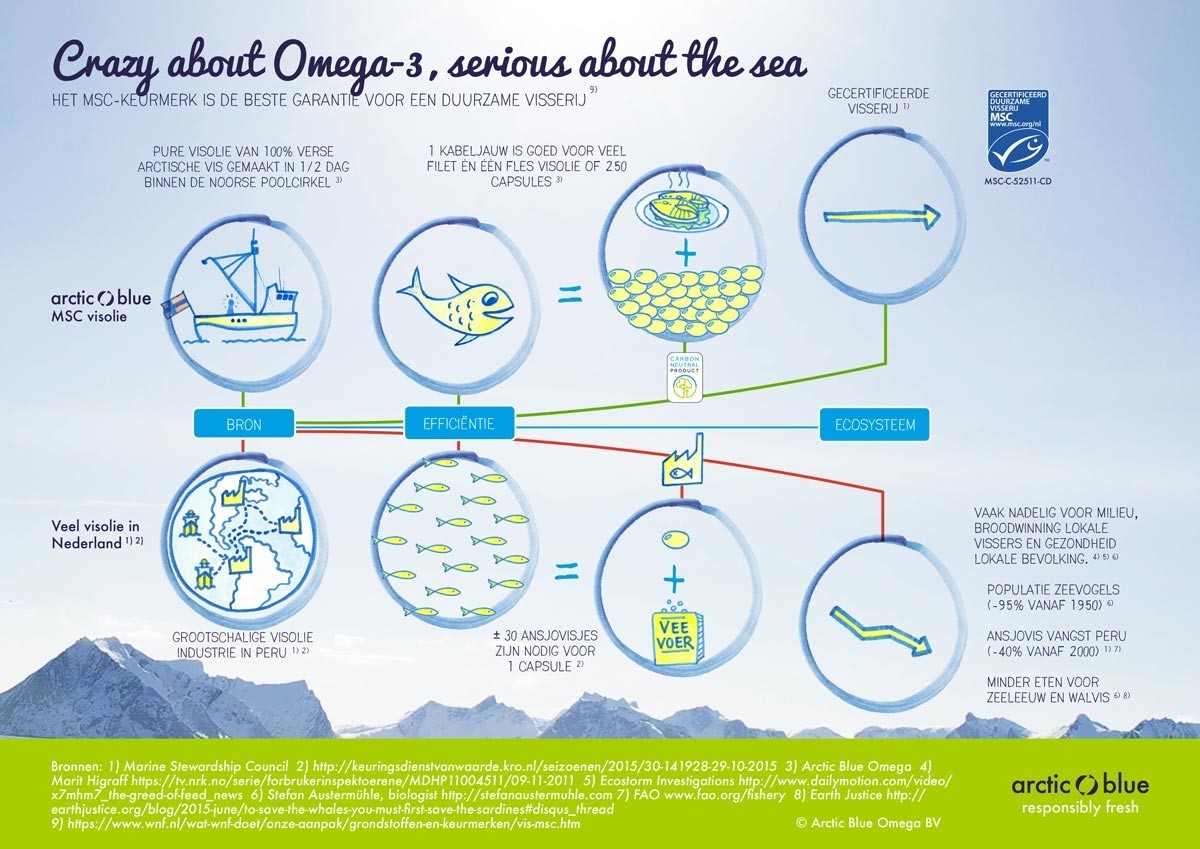
“CRAZY ABOUT OMEGA 3, SERIOUS ABOUT THE SEA”
At Arctic Blue we are ‘crazy about omega-3’, but ‘serious about the sea’. That is why we work with (Arctic) fisheries that take very good care of their sea. The certified (and strictly controlled) blue MSC label ensures optimal fish stocks indefinitely.
In addition, we offer plant-based oil, which is on the rise alongside fish oil as a plant-based alternative. More and more people have a plant-based lifestyle, and we are happy to facilitate that. There is even algae oil available with a higher content of Omega-3 DHA/EPA than in fish oil. We are therefore fully committed to this and already offer 6 different types of algae oil.
What remains is the great advantage of the natural product fish oil: natural (non-concentrated) oil as we offer it from cod or wild salmon has a so-called full spectrum fatty acid profile. This means the oil is a colorful collection of as many as 50 different fatty acids. Exactly in the ratio and quantity in which they occur in these fish in the wild. An exact reflection, in other words. For most fatty acids, we do not even know what their positive contribution in our body is. We see this as something extra that the fish has to offer compared to the widely praised algae oil (with mainly the 2 fatty acids EPA/DHA).
Why is Arctic Blue fish oil truly sustainable?
As one of the few brands in Europe, our fish oil is made 100% from fillet trimmings of wild salmon or cod from Arctic waters. So no fish is specifically caught for it. We cleverly use the leftovers that would otherwise be thrown away. We explain here that working according to these principles also has other quality advantages.
Almost all other brands in the Netherlands use fish oil from anchovies and sardines from South America (Peru), because it is cheaper.
Here, whole fish (anchovy and sardine) are ground up. The KvW (Keuringsdienst van Waarde) has already made a programme about this. Their conclusion was that no fewer than 30 whole anchovies are needed for 1 fish oil capsule. This type of fishery is known as “reduction fisheries”.
And this while these anchovies and sardines are the natural food chain of the dolphin, seabird, sea lion and various species of whales… The KvW viewer fell off their chair, but little has changed since then. That KvW broadcast did motivate me 8 years ago to found Arctic Blue and do things differently. Since then, more than 50,000 Dutch people have switched to Arctic Blue fish oil with the MSC label.
Our Norwegian fishermen often pass their profession down from father to son. Because they have depended for centuries on nature with its healthy fish stocks, they catch a small portion of the Norwegian cod for its fillet, so that their children can become fishermen too. So they have actually always worked according to the strict MSC rules.
The MSC label has been selected by the respected Milieu Centraal as 1 of the 10 best and most credible labels in the Netherlands.
I hope I have given you insight into my personal vision and considerations: The future is certainly plant-based, but a properly made MSC fish oil is absolutely responsible and nutritionally a perfect product.
Unlike many other fish oils, with Arctic Blue you have the guarantee that we keep our hands off the food of the dolphin, seabird, sea lion and whale. And the guarantee that there are no adverse effects on oceans, the environment and local communities.